Below Stairs Margaret Powell

Overview
Powell first arrived at the servants' entrance of one of those great houses in the 1920s. As a kitchen maid – the lowest of the low – she entered an entirely new world; one of stoves to be blacked, vegetables to be scrubbed, mistresses to be appeased, and bootlaces to be ironed. Work started at 5:30am and went on until after dark. It was a far cry from her childhood on the beaches of Hove, where money and food were scarce, but warmth and laughter never were.
Yet from the gentleman with a penchant for stroking the housemaids' curlers, to raucous tea-dances with errand boys, to the heartbreaking story of Agnes the pregnant under-parlormaid, fired for being seduced by her mistress's nephew, Margaret's tales of her time in service are told with wit, warmth, and a sharp eye for the prejudices of her situation.
Margaret Powell's true story of a life spent in service is a fascinating 'downstairs' portrait of the glittering, long-gone worlds behind the closed doors of Downton Abbey and 165 Eaton Place.
Brilliantly evoking the long-vanished world of masters and servants, Margaret Powell's classic memoir of her time in service is the remarkable true story of an indomitable woman who, though she served in the great houses of England, never stopped aiming high. About Press Copyright Contact us Creators Advertise Developers Terms Privacy Policy & Safety How YouTube works Test new features Press Copyright Contact us Creators. Margaret Powell was born in Hove in 1907 and became a kitchen maid at fifteen, eventually progressing to cook. In 1968 the first volume of her memoirs, Below Stairs, was published to instant success, turning her into a celebrity. Below Stairs, by Margaret Powell January 31, 2012 by Charlotte The runaway popularity of the BBC’s Downton Abbey has rekindled an interest in all things upstairs-downstairs, including this memoir, first published in 1968.

Overview Brilliantly evoking the long-vanished world of masters and servants portrayed in Downton Abbey and Upstairs, Downstairs, Margaret Powell's classic memoir of her time in service, Below Stairs, is the remarkable true story of an indomitable woman who, though she served in the great houses of England, never stopped aiming high.
A kitchen-maid's memoir of life in the great houses of 20th century England
Oh sure, the life of a kitchen-maid was all about drudgery and humiliation, but Margaret Powell lets you know right away that there is more to her character than beaten-down servitude. On page three of her riveting, fresh-voiced, fast-paced memoir, she tells us that when she was little, her parents sent her and her siblings to Sunday school not because they were devout but because they needed the privacy for lovemaking - such was life in a large, working class family living together in just a few rooms. Twenty pages later, Powell describes one of her very first jobs. When she was thirteen, she was hired by an aristocratic old woman to push her around town in a bathchair every day. But the woman was so imperious and complained so much, that one day when Powell was steering her along the seafront, she just walked away, leaving her there. 'I never did know what happened to her or how she got back or anything.'
Powell's feistiness does more than simply enliven her account of life in domestic service during the interwar period in England. It sharpens her observations to a fine point and turns her anecdotes into acute critiques of the class system and its hypocrisies.
Her story properly begins when she is thirteen and she wins a scholarship to carry on with her education, but she is unable to accept it because her parents cannot afford to provide her room and board, not to mention books and uniform. After a few false starts in a laundry and a sweet shop, she goes to work in domestic service simply because her mother had done so. She begins as a kitchen maid and, after she learns a few sauces, starts to work her way up to cook, with marginally better pay and more days off. Eventually, she marries and leaves employment in order to raise her family, and many years later she returns to school to complete her education and write her memoirs.
The working conditions for domestic servants were abysmal, but, surprisingly, she was very mobile, changing positions often by answering ads in the newspaper. If she didn't like a particular employer, she could simply leave, though there was no guarantee that the next one would be any better. In this way, she viewed a rather wide variety of families from the bottom up, and her many funny, incisive portraits give her the authority to make judgments about the system in which she was pinioned.
She rightfully objects to the amount of work she is expected to perform each day - when she is handed a list of the kitchen maid's duties, she writes, 'I thought they had made a mistake. I thought it was for six people to do' - but the true target of her ire is the indignity of the profession. Powell's first mistress treats her 'as if I were something subhuman' when she hands her the newspapers with her bare hands rather than placing them first on a silver salver. In her next position, she is kept away from the mistress because she is too 'scruffy,' but 'no one considered that the reason why the kitchen looked so clean, the table white as snow, and the copper saucepans as burnished gold, was the reason [she was] so scruffy.'
She bristles at her employers' constant vigilance over her 'moral welfare,' controlling when she could leave the house, what she could wear, and whom she could see, accompanied by their complete neglect of her 'physical welfare,' her health, and comfort. Powell relishes the look of surprise on her mistress's face when asked if she could borrow a book from the library. 'They knew that you breathed and you slept and you worked, but they didn't know that you read. Such a thing was beyond their comprehension.'
The appeal of interwar costume dramas like Downton Abbey and Upstairs, Downstairs is hardly surprising in this era of collapsed housing prices and a stagnant economy. It is the last gasp of a highly ordered society, the last moments when such unbridled ostentation went so largely uncriticized. But for those viewers who chafe under the overly romanticized portrait of the working class and its acceptance of and intimacy with the elite, Powell's Below Stairs is a pitch-perfect and very modern corrective. It's a way to have your cake and, well, spit in it, too.
After the original (and very successful) publication of Below Stairs in 1968, Margaret Powell became a bit of a celebrity; in this delightfully retro ad from 1971, she encourages consumers to purchase an economical-yet-ever-indulgent food: a British Chicken.
Upstairs Downstairs Book
This review was originally published in The BookBrowse Review in January 2012, and has been updated for the January 2013 edition. Click here to go to this issue.
This review is available to non-members for a limited time. For full access become a member today.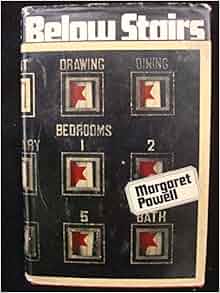
Exterior Cellar Access Stairway
Membership Advantages- Reviews
- 'Beyond the Book' articles
- Free books to read and review (US only)
- Find books by time period, setting & theme
- Read-alike suggestions by book and author
- Book club discussions
- and much more!
- Just $12 for 3 months or $39 for a year.