Calculating Atomic Mass

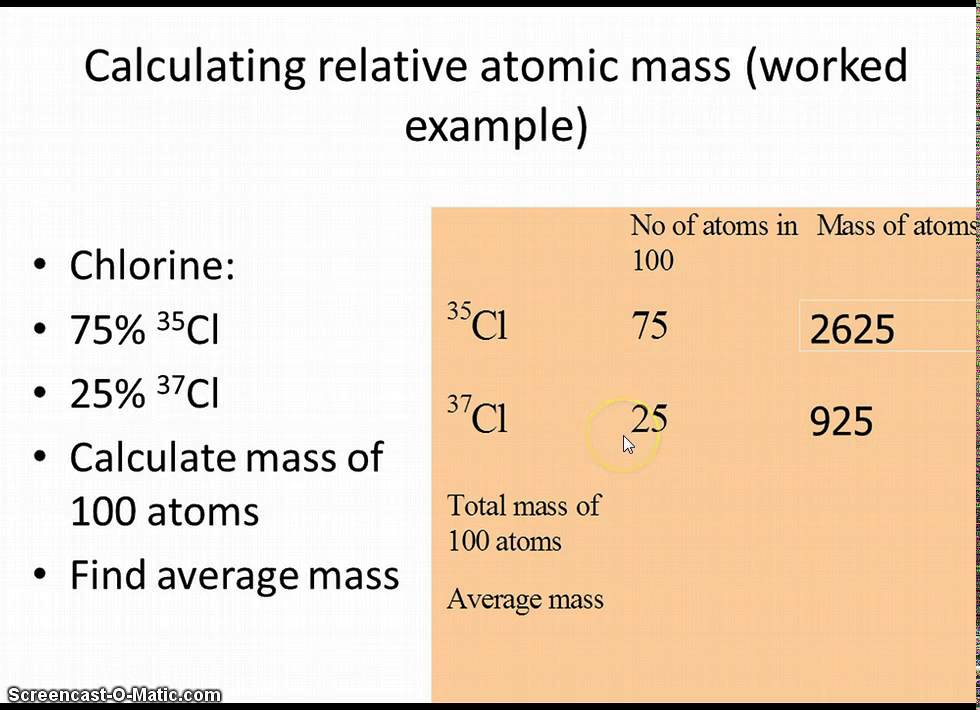
The following formula is used to calculate the average atomic mass of a substance. AM = f 1 M 1 + f 2 M 2 + + f n M n Where AM is the average atomic mass fn is the fractional percent of the isotope. ATOMIC MASS.TO CALCULATE THE ATOMIC MASS OF AN ELEMENT, MULTIPLY THE MASS OF EACH ISOTOPE BY ITS NATURAL ABUNDANCE, EXPRESSED AS A DECIMAL, AND THEN ADD THE PRODUCTS. SAMPLE PROBLEM 1.RUBIDIUM HAS TWO COMMON ISOTOPES, 85-RB AND 87-RB.
- Atomic Structure - Atomic massThis is a very prep-friendly lab for teachers to use when they wish to teach their students about atomic mass calculations. Students use a fictitious element called “Candium” to calculate the average atomic mass from three different isotopes. Students have practice wi.
- Note: The atomic mass is the mass of an a What information do you need to calculate Note: To calculate the average atomic mas Calculate the atomic mass for carbon using Mass Percent Abundance carbon-12 12.00 Note: 12.01 amu atomic masses We need to take into account the percent e what is called the weighted average. The atomic mass of an.
- The atomic mass of an atom is the number of times it is heavier than 1/12 an atom of C-12. The atomic mass of hydrogen is 1 amu; an atom of hydrogen is 1/12 the mass of an atom of C-12. Grams are the standard unit to express mass but because atoms are so small, grams or milligrams are not convenient to express the numbers of atomic mass.
1 u = 1.66 × 10⁻²⁷ kg
We can estmate the the relative atomic mass (atomic weight) of an element E with the naturally occurring isotopes aE, bE, cE, etc, and with the respective abundances of ACalculating Atomic Mass Of Isotopes
%, B%, C% etc,| relative atomic mass (r.a.m.) | = ( | A 100 | × a) | + ( | B 100 | × b) | + ( | C 100 | × c) | + etc |
and 100 - x = %abundance of isotope-b
then, let r.a.m = relative atomic mass of the element:
| r.a.m. | = ( | x 100 | × mass isotope-a) | + ( | 100 - x 100 | × mass isotope-b) |
and solve for x
1 u = 1.66 × 10⁻²⁷ kg
We can estmate the the relative atomic mass (atomic weight) of an element E with the naturally occurring isotopes aE, bE, cE, etc, and with the respective abundances of A%,Calculating Atomic Mass Numbers
B%, C% etc,| relative atomic mass (r.a.m.) | = ( | A 100 | × a) | + ( | B 100 | × b) | + ( | C 100 | × c) | + etc |
and 100 - x = %abundance of isotope-b
then, let r.a.m = relative atomic mass of the element:
| r.a.m. | = ( | x 100 | × mass isotope-a) | + ( | 100 - x 100 | × mass isotope-b) |
and solve for x