Markdown In Rstudio

- As the R Markdown Notebook is native to the RStudio development kit, the notebooks will seamlessly integrate with your R projects. Also, these notebooks support other languages, including Python, C.
- The first official book authored by the core R Markdown developers that provides a comprehensive and accurate reference to the R Markdown ecosystem. With R Markdown, you can easily create reproducible data analysis reports, presentations, dashboards, interactive applications, books, dissertations, websites, and journal articles, while enjoying the simplicity of Markdown and the great power of.
- Introduction R Markdown is one of the most popular data science tools and is used to save and execute code to create exceptional reports whice are easily shareable. The documents that R Markdown.
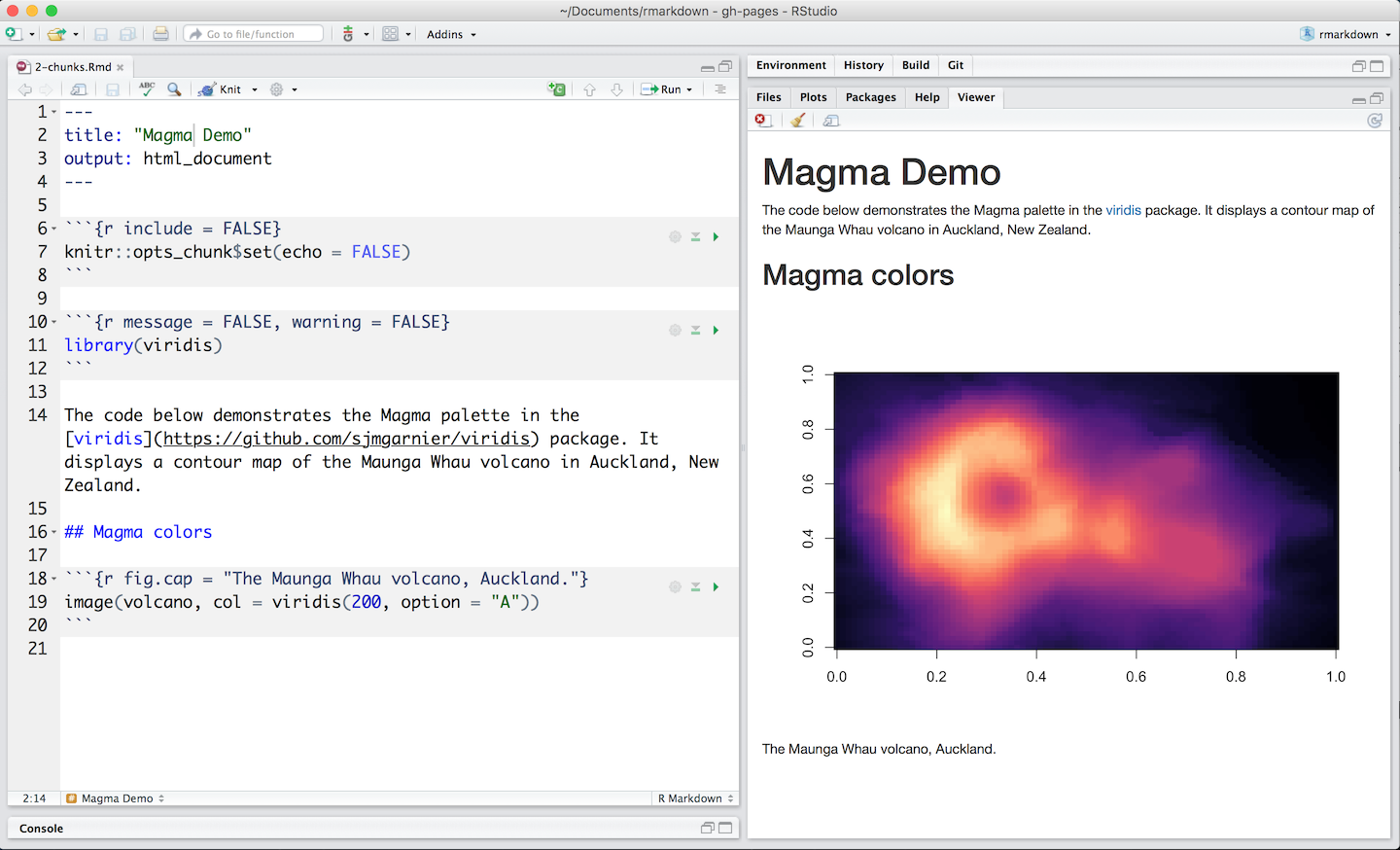
Default site description. We use the knitR package to compile R markdown documents. The specific function used to compile is the knit function, which takes a filename as input. RStudio provides a button that makes it easier to compile the document. For the screenshot below, we have edited the document so that a report on gun murders is produced.
November 2020
- Hints and Examples
Stata notes | Stata and R Markdown
Introduction
This is an introduction to writing dynamic documents using R Markdown to produce documents based on Stata. This process uses Rstudio (or just R) to create documents that depend upon Stata code. The source for this document is StataMarkdown.rmd
Background
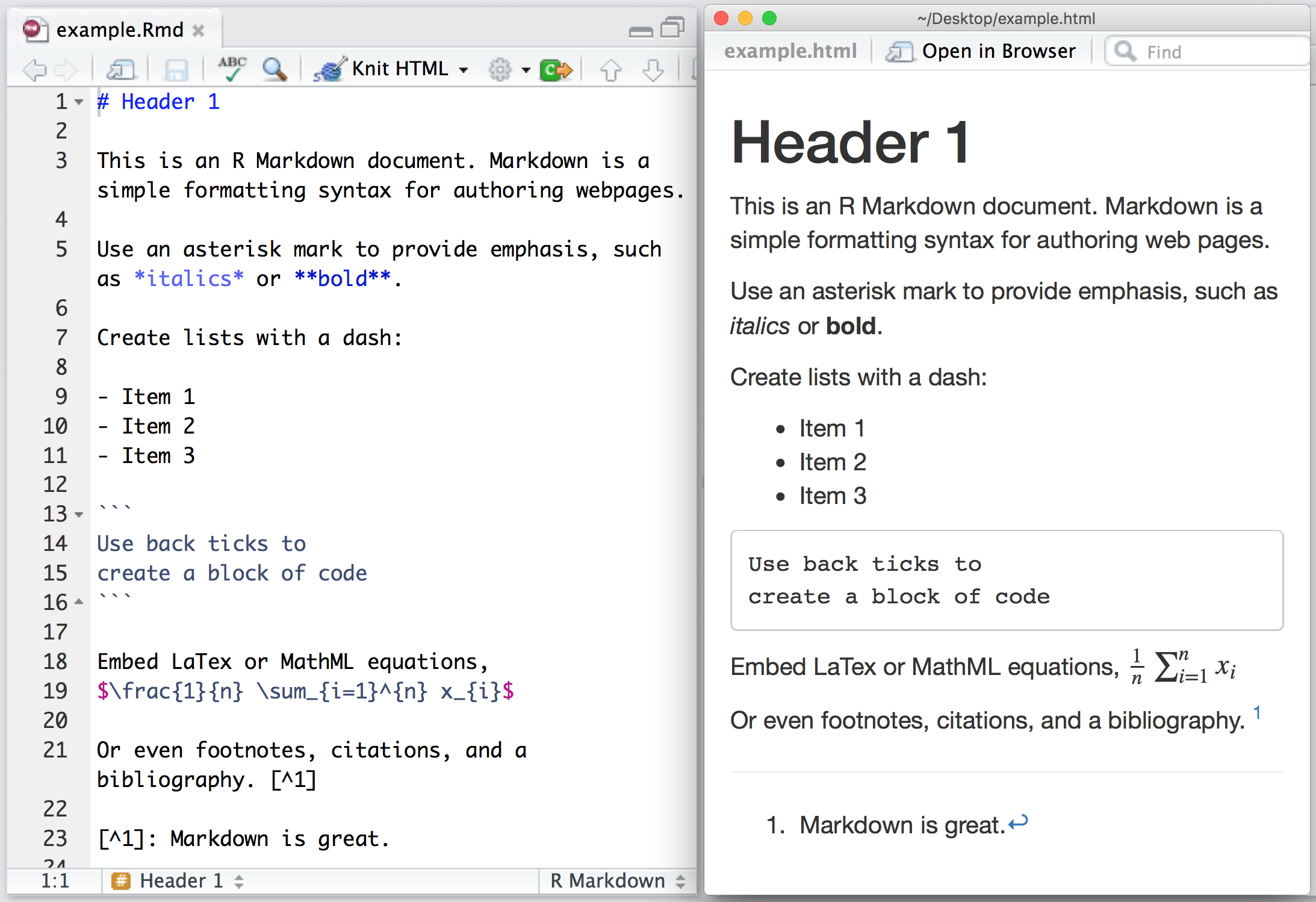
Markdown is a language for formatting not-too-complicated documents using just a few text symbols. It is designed to be easy to read and write. If you read and write email, you are probably already familiar with many of these formatting conventions. For more specifics about Markdown see John Gruber's Markdown article.
Dynamic Markdown has been implemented for a number of programming languages, including Stata and R. Within Stata there is a dynamic markdown package called stmd that relies on Stata's dyndoc command, as well as the user-written package markstat. Each has it's strengths and weaknesses.
The system I will describe here is intended primarily for those of us who are already using R Markdown to write documentation in other languages, and would like to use this for Stata as well.
R Markdown is a dynamic markdown system that extends Markdown by allowing you to include blocks of code in one of several programming languages. The code is evaluated, and both the code and it's results are included in a Markdown document. To read more about the details of R Markdown see RStudio's R Markdown webpages
RStudio uses an R package called knitr (this could also be called directly from R), which includes the ability to evaluate Stata.
The documentation for knitr can be found in R's Help, from Yihui Xie's web page, or in the book, R Markdown: The Definitive Guide.
Finally, I use some helper functions in a package called Statamarkdown. While these are not necessary to write dynamic documents based on Stata, they make life easier.
Statamarkdown can be installed from github.com.

Note, RStudio is a great environment for writing Markdown with executable R code chunks, but it is not a friendly environment for extensively debugging problems in your Stata code. If your Stata code is complicated, you should probably work out the details in Stata first, then pull it into RStudio to develop your documentation!

Setting up the Stata engine
In order to execute your Stata code, knitr needs to know where the Stata executable is located. This can be done with a preliminary code chunk, by loading the Statamarkdown package:
(In knitr jargon, a block of code is a 'code chunk'.)
If the package fails to find your copy of Stata (you will see a message), you may have to specify this yourself (see Stata Engine Path).
After this setup chunk, subsequent code to be processed by Stata can be specified as:
Linking Code Blocks
Each block (chunk) of Stata code is executed as a separate batch job. This means that as you move from code chunk to code chunk, all your previous work is lost. To retain data from code chunk to code chunk requires collecting (some of) your code and processing it silently at the beginning of each subsequent chunk.
You can have knitr collect code for you, as outlined in Linking Stata Code Blocks and as illustrated below.
Hints and Examples
Code Separate or with Output
Stata does not give you fine control over what ends up in the .log file. You can decide whether to present code and output separately (R style), or include the code in the output (Stata style).
See Stata Output Hooks).
Including Graphs
Including graphics requires graph export in Stata, and an image link in the R Markdown. The knitr chunk option echo can print just specified lines of code, allowing you to hide the graph export command as illustrated below.
Frequency Tables
Using chunk options echo=FALSE, cleanlog=FALSE, yields a more typical Stata documentation style.
Graphics
The example uses the knitr chunk options results='hide' to suppress the log and echo=1 to show only the Stata graph box command that users need to see.
(This page was written using Statamarkdown version 0.5.5.)
R Markdown documents allow you to embed code chunks (of R or other languages) inMarkdown documents and are fully reproducible. Use a productive notebookinterface to weave together narrative text and code to produce elegantlyformatted output. Use multiple languages including R, Python, and SQL.
R Markdown supports dozens of static and dynamic output formats including HTML,PDF, MS Word, Beamer, HTML5 slides, Tufte-style handouts, books, dashboards,Shiny applications, scientific articles, websites, and more.
Markdown Rstudio Example
Visit the R Markdown website for more information. Paragon ntfs for mac 15 serial number free. Apple magic keyboard usb c port.