Mole Number

Mole is the SI unit used to measure how many molecules or atoms there are. One mole is around 600 sextillion molecules. Scientists use this number because 1 gram of hydrogen is around 1 mole of atoms. The exact value of one mole is 6.022 140 78 × 1023. Moles are a common type of skin growth. They often appear as small, dark brown spots and are caused by clusters of pigmented cells. Moles generally appear during childhood and adolescence. Most people have 10 to 40 moles, some of which may change in appearance or fade away over time.
Figure (PageIndex{1}) shows that we need 2 hydrogen atoms and 1 oxygen atom to make 1 water molecule. If we want to make 2 water molecules, we will need 4 hydrogen atoms and 2 oxygen atoms. If we want to make 5 molecules of water, we need 10 hydrogen atoms and 5 oxygen atoms. The ratio of atoms we will need to make any number of water molecules is the same: 2 hydrogen atoms to 1 oxygen atom.
One problem we have, however, is that it is extremely difficult, if not impossible, to organize atoms one at a time. As stated in the introduction, we deal with billions of atoms at a time. How can we keep track of so many atoms (and molecules) at a time? We do it by using mass rather than by counting individual atoms.
A hydrogen atom has a mass of approximately 1 u. An oxygen atom has a mass of approximately 16 u. The ratio of the mass of an oxygen atom to the mass of a hydrogen atom is therefore approximately 16:1.
If we have 2 atoms of each element, the ratio of their masses is approximately 32:2, which reduces to 16:1—the same ratio. If we have 12 atoms of each element, the ratio of their total masses is approximately (12 × 16):(12 × 1), or 192:12, which also reduces to 16:1. If we have 100 atoms of each element, the ratio of the masses is approximately 1,600:100, which again reduces to 16:1. As long as we have equal numbers of hydrogen and oxygen atoms, the ratio of the masses will always be 16:1.
The same consistency is seen when ratios of the masses of other elements are compared. For example, the ratio of the masses of silicon atoms to equal numbers of hydrogen atoms is always approximately 28:1, while the ratio of the masses of calcium atoms to equal numbers of lithium atoms is approximately 40:7.
So we have established that the masses of atoms are constant with respect to each other, as long as we have the same number of each type of atom. Consider a more macroscopic example. If a sample contains 40 g of Ca, this sample has the same number of atoms as there are in a sample of 7 g of Li. What we need, then, is a number that represents a convenient quantity of atoms so we can relate macroscopic quantities of substances. Clearly even 12 atoms are too few because atoms themselves are so small. We need a number that represents billions and billions of atoms.
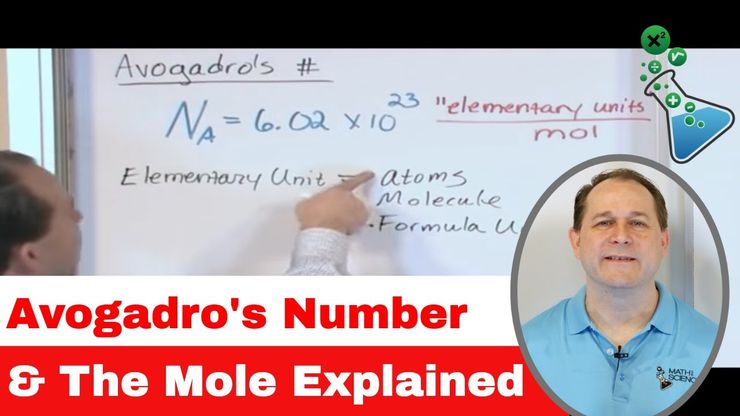
Chemists use the term mole to represent a large number of atoms or molecules. Just as a dozen implies 12 things, a mole (abbreviated as mol) represents 6.022 × 10²³ things. The number 6.022 × 10²³, called Avogadro’s number after the 19th-century chemist Amedeo Avogadro, is the number we use in chemistry to represent macroscopic amounts of atoms and molecules. Thus, if we have 6.022 × 10²³ Na atoms, we say we have 1 mol of Na atoms. If we have 2 mol of Na atoms, we have 2 × (6.022 × 1023) Na atoms, or 1.2044 × 1024 Na atoms. Similarly, if we have 0.5 mol of benzene (C6H6) molecules, we have 0.5 × (6.022 × 1023) C6H6 molecules, or 3.011 × 10²³ C6H6 molecules.
A mole represents a very large number! If 1 mol of quarters were stacked in a column, it could stretch back and forth between Earth and the sun 6.8 billion times.
Notice that we are applying the mole unit to different types of chemical entities. The word mole represents a number of things—6.022 × 10²³ of them—but does not by itself specify what “they” are. The chemical entities can be atoms,molecules, formula units and ions. This specific information needs to be specified accurately. Most students find this confusing hence, we need to review the composition of elements, covalent and ionic compounds.
Most elements are made up of individual atoms, such as helium. However, some elements consist of molecules, such as the diatomic elements, nitrogen, hydrogen, oxygen, etc. discussed in Section 2.2. One mole of He consists of 6.022 × 10²³ He atoms but one mole of nitrogen contains 6.022 × 10²³ N2molecules. The basic units of covalent (molecular) compounds are molecules as well. The molecules of 'compounds' consist of different kinds of atoms while the molecules of 'elements' consist of only one type of atom. For example, the molecules of ammonia (NH3) consist of nitrogen and hydrogen atoms while N2 molecules have N atoms only. Compounds that are ionic, like NaCl, are represented by ionic formulas. One mole of NaCl, for example, refers to 6.022 × 10²³ formula units of NaCl. And, one formula unit of NaCl consists of one sodium ion and one chloride ion. Figure 6.1.2 summarizes the basic units of elements, covalent and ionic compounds
Conversion Between Moles and Atoms, Molecules and Ions
Using our unit conversion techniques learned in Chapter 1, we can use the mole relationship and the chemical formula to convert back and forth between the moles and the number of chemical entities (atoms, molecules or ions).
My albums. Because 1 N2 molecule contains 2 N atoms, 1 mol of N2 molecules (6.022 × 10²³ molecules) has 2 mol of N atoms. Using formulas to indicate how many atoms of each element we have in a substance, we can relate the number of moles of molecules to the number of moles of atoms. For example, in 1 mol of ethanol (C2H6O), we can construct the following relationships (Table (PageIndex{1})):
| 1 Molecule of (C_2H_6O) Has | 1 Mol of (C_2H_6O) Has | Molecular Relationships |
|---|---|---|
| 2 C atoms | 2 mol of C atoms | (mathrm{dfrac{2: mol: C: atoms}{1: mol: C_2H_6O: molecules}}) or (mathrm{dfrac{1: mol: C_2H_6O: molecules}{2: mol: C: atoms}}) |
| 6 H atoms | 6 mol of H atoms | (mathrm{dfrac{6: mol: H: atoms}{1: mol: C_2H_6O: molecules}}) or (mathrm{dfrac{1: mol: C_2H_6O: molecules}{6: mol: H: atoms}}) |
| 1 O atom | 1 mol of O atoms | (mathrm{dfrac{1: mol: O: atoms}{1: mol: C_2H_6O: molecules}}) or (mathrm{dfrac{1: mol: C_2H_6O: molecules}{1: mol: O: atoms}}) |
The following example illustrates how we can use these relationships as conversion factors.
Example (PageIndex{1})
If a sample consists of 2.5 mol of ethanol (C2H6O), how many moles of carbon atoms, hydrogen atoms, and oxygen atoms does it have?
Solution
Using the relationships in Table (PageIndex{1}), we apply the appropriate conversion factor for each element:
Note how the unit mol C2H6O molecules cancels algebraically. Similar equations can be constructed for determining the number of H and O atoms:
(mathrm{2.5: mol: C_2H_6O: moleculestimesdfrac{6: mol: H: atoms}{1: mol: C_2H_6O: molecules}=15: mol: H: atoms})
(mathrm{2.5: mol: C_2H_6O: moleculestimesdfrac{1: mol: O: atoms}{1: mol: C_2H_6O: molecules}=2.5: mol: O: atoms})
Exercise (PageIndex{1})
If a sample contains 6.75 mol of Na2SO4, how many moles of sodium atoms, sulfur atoms, and oxygen atoms does it have?
13.5 mol Na, 6.75 mol S and 27 mol O.
We can use Avogadro's number as a conversion factor, or ratio, in dimensional analysis problems. For example, if we are dealing with element X, the mole relationship is expressed as follows:
[text{1 mol X} = 6.022 times 10^{23} text{ X atoms}]
We can convert this relationship into two possible conversion factors shown below:
(mathrm{dfrac{1: mol: X: }{6.022times 10^{23}: X: atoms}}) or (mathrm{dfrac{6.022times 10^{23}: X: atoms}{1: mol: X: }})
If the number of 'atoms of element X' is given, we can convert it into 'moles of X' by multiplying the given value with the conversion factor at the left. However, if the number of 'mol of X' is given, the appropriate conversion factor to use is the one at the right.
If we are dealing with a molecular compound (such as C4H10), the mole relationship is expressed as follows:
[text{1 mol C4H10} = 6.022 times 10^{23} text{ C4H10 molecules}]
If working with ionic compounds (such as NaCl), the mole relationship is expressed as follows:
[text{1 mol NaCl} = 6.022 times 10^{23} text{ NaCl formula units}]
Example (PageIndex{2})
How many formula units are present in 2.34 mol of NaCl? How many ions are in 2.34 mol?
Solution
Typically in a problem like this, we start with what we are given and apply the appropriate conversion factor. Here, we are given a quantity of 2.34 mol of NaCl, to which we can apply the definition of a mole as a conversion factor:
(mathrm{2.34: mol: NaCltimesdfrac{6.022times10^{23}: NaCl: units}{1: mol: NaCl}=1.41times10^{24}: NaCl: units})
Because there are two ions per formula unit, there are
(mathrm{1.41times10^{24}: NaCl: unitstimesdfrac{2: ions}{NaCl: units}=2.82times10^{24}: ions})
in the sample.
Exercise (PageIndex{2})
How many molecules are present in 16.02 mol of C4H10? How many atoms are in 16.02 mol?
9.647 x 1024molecules, 1.351 x 1026 atoms.
Answer
Key Takeaway
- A mole is 6.022 × 10²³ things.
Exercises
How many dozens are in 1 mol? Express your answer in proper scientific notation.
A gross is a dozen dozen, or 144 things. How many gross are in 1 mol? Express your answer in proper scientific notation.
How many moles of each type of atom are in 1.0 mol of C6H12O6?
How many moles of each type of atom are in 1.0 mol of K2Cr2O7?
How many moles of each type of atom are in 2.58 mol of Na2SO4?
How many moles of each type of atom are in 0.683 mol of C34H32FeN4O4? (This is the formula of heme, a component of hemoglobin.)

How many formula units are in 0.778 mol of iron(III) nitrate?
A sample of gold contains 7.02 × 1024 atoms. How many moles of gold is this?
A flask of mercury contains 3.77 × 10²² atoms. How many moles of mercury are in the flask?
An intravenous solution of normal saline may contain 1.72 mol of sodium chloride (NaCl). How many sodium and chlorine atoms are present in the solution?
A lethal dose of arsenic is 1.00 × 10²¹ atoms. How many moles of arsenic is this?

Answers
6.0 mol of C atoms, 12.0 mol of H atoms, and 6.0 mol of O atoms
5.16 mol of Na atoms, 2.58 mol of S atoms, and 10.32 mol of O atoms
Mole Number Units
11. 1.04 × 1024 Na atoms and 1.04 × 1024 Cl atoms
What would happen if you were to gather a mole (unit of measurement) of moles (the small furry critter) in one place?
—Sean Rice
Things get a bit gruesome.
First, some definitions. A mole is a unit. It’s not a typical unit,though. It’s really just a number—like “dozen” or “billion.” If you havea mole of something, it means you have 602,214,129,000,000,000,000,000of them (usually written ( 6.022times10^{23} )). It’s such a bignumber because it’s used for counting numbers of molecules, which thereare a lot of.
'One mole' is close to the number of atoms in a gram of hydrogen. It’salso, by chance, a decent ballpark guess for the number of grains ofsand on Earth.
A mole is also a type of burrowing mammal. There are a handful of typesof moles, and some of them are trulyhorrifying.
So what would a mole of moles—602,214,129,000,000,000,000,000animals—look like?
Mole Number
First, let’s start with wild ballpark approximations. This is an exampleof what might go through my head before I even pick up a calculator,when I’m just trying to get a sense of the quantities - the kind ofcalculation where 10, 1, and 0.1 are all close enough that we canconsider them equal:
I can pick up a mole (animal) and throw it.[citation needed] Anything I can throw weighs one pound. One pound is one kilogram. Thenumber 602,214,129,000,000,000,000,000 looks about twice as long as atrillion, which means it’s about a trillion trillion. I happen toremember that a trillion trillion kilograms is how much a planet weighs.
… if anyone asks, I did not tell you it was ok to do math like this.
That’s enough to tell us that we’re talking about pile of moles on thescale of planets. It’s a pretty rough estimate, though, since it couldbe off by a factor of thousands in either direction.
Let’s get some better numbers.
An eastern mole (Scalopus aquaticus) weighs about 75 grams, whichmeans a mole of moles weighs
[(6.022times10^{23})times75mathrm{g}approx4.52times10^{22}mathrm{kg}]
Mole Number Of Nacl
That’s a little over half the mass of our moon.
Mammals are largely water. A kilogram of water takes up a liter ofvolume, so if the moles weigh ( 4.52times10^{22} ) kilograms,they take up about ( 4.52times10^{22} ) liters of volume. Youmight notice that we’re ignoring the pockets of space between the moles.In a moment, you’ll see why.
The cube root of ( 4.52times10^{22} ) liters is 3,562 kilometers,which means we’re talking about a sphere with a radius of 2,210kilometers, or a cube 2,213 miles on each edge. (That’s a neatcoincidence I’ve never noticed before—a cubic mile happens to be almostexactly ( frac{4}{3}pi ) cubic kilometers, so a sphere with aradius of X kilometers has the same volume as a cube that’s X miles oneach side.)
If these moles were released onto the Earth’s surface, they’d fill it upto 80 kilometers deep—just about to the (former) edge of space:
This smothering ocean of high-pressure meat would wipe out most life onthe planet, which could—to reddit’s horror—threaten the integrity of theDNS system. So doing this on Earth is definitely not an option.
Instead, let’s gather the moles in interplanetary space. Gravitationalattraction would pull them into a sphere. Meat doesn’t compress verywell, so it would only undergo a little bit of gravitationalcontraction, and we’d end up with a mole planet a bit larger than themoon.
The moles would have a surface gravity about one-sixteenth as strong asEarth’s—similar to that of Pluto. The planet would start off uniformlylukewarm—probably a bit over room temperature—and the gravitationalcontraction would heat the deep interior by a handful of degrees.
But this is where it gets weird.
The mole planet is now a giant sphere of meat. It has a lot of latentenergy (there are enough calories in the mole planet to support theEarth’s current population for 30 billion years). Normally, when organicmatter decomposes, it releases much of that energy as heat. Butthroughout the majority of the planet’s interior, the pressure is over ahundred megapascals, which is enough to kill all bacteria and sterilizethe mole remains—leaving no microorganisms to break down the moletissues.
Closer to the surface, where the pressure is lower, there’s anotherobstacle to decomposition—the interior of a mole planet is low inoxygen. Without oxygen, the usual decomposition doesn’t happen, and theonly bacteria that can break down the moles are those which don’trequire oxygen. While inefficient, this anaerobic decomposition canunlock quite a bit of heat. If continued unchecked, it would heat theplanet to a boil.
But the decomposition is self-limiting. Few bacteria can survive attemperatures above about 60 °C, so as the temperature goes up, thebacteria die off, and the decomposition slows. Throughout the planet,the mole bodies gradually break down into kerogen, a mush of organicmatter which would—if the planet were hotter—eventually form oil.
The outer surface of the planet radiates heat into space and freezes.Because the moles form a literal fur coat, when frozen it insulates theinterior of the planet and slows the loss of heat to space. However, theflow of heat in the liquid interior is dominated by convection. Plumesof hot meat and bubbles of trapped gases like methane—along with the airfrom the lungs of the deceased moles—periodically rise through the molecrust and erupt volcanically from the surface, a geyser of deathblasting mole bodies free of the planet.
Eventually, after centuries or millennia of turmoil, the planet calmsand cools enough that it begins to freeze all the way through. The deepinterior is under such high pressure that as it cools, the watercrystallizes out into exotic forms ofice such as ice III and ice V,and eventually ice II and ice IX (norelation).
All told, this is a pretty bleak picture. Let’s try an alternateapproach.
I don’t have any reliable numbers for global mole population (or smallmammal biomass in general), but we’ll take a shot in the dark andestimate that there are at least a few dozen mice, rats, voles, andother small mammals for every human.
Mole Number Of Particles Relationship
There might be a billion habitableplanetsin our galaxy. If we colonized them, we’d certainly bring mice and ratswith us. If just one in a hundred were populated with small mammals innumbers similar to Earth’s, after a few million years—not long, inevolutionary time—the total number which have ever lived would surpassAvogadro’s number.
Mole In Chemistry
If you want a mole of moles, build a spaceship.