Ruth Bader Ginsburg Memoir

Affectionately called “R.B.G.” by her supporters, Ruth Bader Ginsburg has inspired generations of women to break gender barriers. Even after facing gender discrimination as she pursued her academic goals, Ginsburg forged ahead and became the second woman--and first Jewish woman--to serve on the Supreme Court.
Ruth Bader Ginsburg was born on March 15, 1933 in Brooklyn, New York. Born to a Jewish family, her father Nathan Bader immigrated to the United States, while her mother Celia Amster Bader was a native of New York. Ginsburg’s family valued education and instilled in her a love of learning. She attended P.S. 238 for elementary school and James Madison High School in Brooklyn before continuing on to attend Cornell University. Ginsburg graduated from Cornell with a bachelor’s degree in 1954, earning high honors in Government and distinction in all subjects. She was also the College of Arts and Sciences Class Marshal. That same year, she married Martin D. Ginsburg and the couple have two children together.
'De Hart dynamically devotes more than 500 pages to the amazing life of Supreme Court Justice Ruth Bader Ginsburg. Telling anecdotes skillfully illuminate Ginsburg's devotion to her family and her wonderfully supportive late husband, her long-standing friendships with an array of public figures, her love of opera, and her humorous wit. Ruth Bader Ginsburg (1933—2020) spent her life working tirelessly for a more just society, says Amanda Tyler, Shannon C. Turner Professor of Law at Berkeley and former law clerk to the Supreme Court Justice. She recommends the best books to read about RBG: her life, her work, and even her personal training regime. Interview by Eve Gerber. Ruth Bader Ginsburg Biography Ruth Bader Ginsburg, an American lawyer and jurist, is famous for being a trailblazer and champion for equal rights for women. She has served on the U.S. Supreme Court since 1993. She was born in a working class neighborhood of Brooklyn, New York in 1933. When Ruth Bader Ginsburg began her career as an attorney, America's courtrooms and law firms were virtually all-male preserves. Female attorneys were a rarity, female judges were almost unheard of, and in many states women were routinely dismissed from jury duty. As one of the few women studying at Harvard Law School in the 1950s, Ruth Bader Ginsburg was asked to justify taking a place in the.
After graduating from Cornell, Ginsburg subsequently started attending Harvard Law School. While at Harvard, Ginsburg was one of only 9 women in a class of 500 students. She often faced gender discrimination and was asked to explain how she felt about taking a spot in the program instead of a man. Ginsburg and her female colleagues were called on in class for “comic relief” and they were even excluded from using certain sections of the library. Ginsburg transferred to Columbia Law School in 1958 for her final year. During her studies, she made both the Harvard and Columbia Law Review. Ginsburg graduated with her law degree from Columbia in 1959 at the top of her class. However, even with all of her academic accomplishments, it was hard for her to find employment after graduation. She explained, “In the fifties, the traditional law firms were just beginning to turn around on hiring Jews. … But to be a woman, a Jew, and a mother to boot, that combination was a bit much.”[1] Ginsburg was able to land a position as a law clerk for the Honorable Edmund L. Palmieri, Judge of the United States District Court for the Southern District of New York in 1959. She served in that office until 1961.
Following her clerkship, Ginsburg began working as a research associate for the Columbia Law School Project on International Procedure. After a year as a research associate, she became the associate director and continued in that position for a year. In 1963, Ginsburg began as a Professor of Law at Rutgers University School of Law and taught classes until 1972. She also became involved with the American Civil Liberties Union (ACLU) and she was central to the founding of their Women’s Rights Project in 1971. Ginsburg returned to Columbia Law School in 1972, where she became the first woman hired to receive tenure. While teaching at Columbia, she also served as the general counsel for the ACLU from 1973-1980 and on the National Board of Directors from 1974–1980. During that time, she became a fellow at the Center for Advanced Study in the Behavioral Sciences in Stanford, California from 1977-1978.
Ginsburg was appointed to the United States Court of Appeals for the District of Columbia Circuit in 1980 by President Jimmy Carter. She served there for thirteen years, prior to being nominated as an Associate Justice of the Supreme Court by President Bill Clinton in 1993. She accepted his nomination and took her seat as a Supreme Court Justice on August 10, 1993. She became the second woman, and first Jewish woman, to serve on the Supreme Court. During her tenure as a justice, Ginsburg has fiercely advocated for gender equality and women’s rights. For example, she wrote the court’s opinion in the United States v. Virginia case, ruling that qualified women could not be denied admission to the Virginia Military Institute. She was also a voice of dissent to the court’s decision in the Ledbetter v. Goodyear Tire & Rubber Co. case, denying a woman’s gender pay discrimination claim. Ginsburg subsequently worked with President Barack Obama in 2009 on the Lilly Ledbetter Fair Pay Act to combat pay disparities. At eighty-seven years old, Ginsburg continued to work for gender equality as a Supreme Court Justice.
Ginsburg died on September 18, 2020 due to complications of metastatic pancreas cancer.
[1] Margolick, David. “Trial by Adversity Shapes Jurist's Outlook.” The New York Times. The New York Times, June 25, 1993. https://www.nytimes.com/1993/06/25/us/trial-by-adversity-shapes-jurist-s-outlook.html.
- Legal Information Institute. “US Supreme Court: Justice Ginsburg.” Cornell Law School. Accessed April 15, 2020. https://www.law.cornell.edu/supct/justices/ginsburg.bio.html.
- Margolick, David. “Trial by Adversity Shapes Jurist's Outlook.” The New York Times. The New York Times, June 25, 1993. https://www.nytimes.com/1993/06/25/us/trial-by-adversity-shapes-jurist-s-outlook.html.
- Steinmetz, Katy. “How Ruth Bader Ginsburg's Found Her Voice.” Time Magazine. Accessed April 15, 2020. https://time.com/ruth-bader-ginsburg-supreme-court/.
- Supreme Court of the United States. “About the Court: Current Members.” Accessed April 15, 2020. https://www.supremecourt.gov/about/biographies.aspx.
- Vogue, Ariane de. “Justice Ruth Bader Ginsburg Dominates in Abortion Case.” CNN, March 6, 2020. https://www.cnn.com/2020/03/05/politics/ruth-bader-ginsburg-abortion-louisiana/index.html.
Photograph: Public domain
MLA – Alexander, Kerri Lee. “Ruth Bader Ginsburg.” National Women’s History Museum, 2020. Date accessed.
Chicago – Alexander, Kerri Lee. “Ruth Bader Ginsburg” National Women’s History Museum. 2020. www.womenshistory.org/education-resources/biographies/ruth-bader-ginsburg.
Hirshman, Linda. “Sisters in Law.” C-SPAN.org, September 3, 2015. https://www.c-span.org/video/?327947-1/linda-hirshman-sisters-law.
New York based publisher Simon & Schuster has announced in a press release that it will be publishing Justice Ruth Bader Ginsburg's memoir My Own Words in January 2017. According to the description in the announcement, the collection of Ginsburg's past speeches and writings will serve as a precursor to an upcoming biography on the second female Justice in America. Upon opening the memoir, readers will first flip to an introduction written by Bader Ginsburg herself. From there, biographers Mary Hartnett and Wendy W. Williams will introduce each of the following chapters, which are projected to include Bader Ginsburg's past quotes and interviews on a variety of topics close to Bader Ginsburg's heart and reflective of her career as an activist and Supreme Court Justice. Main talking points will include gender equality, the functioning of the Supreme Court, Jewish identity, opera, and the interpretation of the Constitution. RBG fans are surely hoping the memoir will kindly dedicate a section to her famous collection of lace jabots, as well, but that has yet to be confirmed.

Bader Ginsburg has held her seat as Supreme Court Justice for over 20 years. My Own Words, the first book she has written during her tenure, will present itself as an inspiring synopsis of her progressive stances, life lessons, and political knowledge. Simon & Schuster Vice President and Editorial Director Alice Mayhew released a statement on the publication's partnership with Bader Ginsburg.
Simon & Schuster is proud and thrilled to publish MyOwn Words by Justice Ginsburg in anticipation of her authorized biography. Justice Ginsburg is one of the most important and articulate legal thinkers and interpreters in the country. She is also a witty and engaged writer and speaker, and I am personally delighted to have another opera lover on board.
Bader Ginsburg has a long history of women's rights activism of which America should be incredibly proud. In the 1970s, she was the first female professor to be hired with tenure at Columbia University School of Law. While teaching law courses, she simultaneously worked for the American Civil Liberties Union, where she helped found the Women's Rights Project and advocated for Congress' passing of the Equal Rights Amendment. Ginsburg said she'd been taught from a young age to further equality and cherish independence.
My mother told me two things constantly. One was to be a lady, and the other was to be independent. The study of law was unusual for women of my generation. For most girls growing up in the '40s, the most important degree was not your B.A., but your M.R.S.
Once elected to the Supreme Court by former President Bill Clinton in 1993, Bader Ginsburg spearheaded historic strides towards equality for all Americans. Even then, during a 1993 Senate confirmation meeting, she strongly advocated for a woman's right to choose — a topic that is still heatedly debated today.
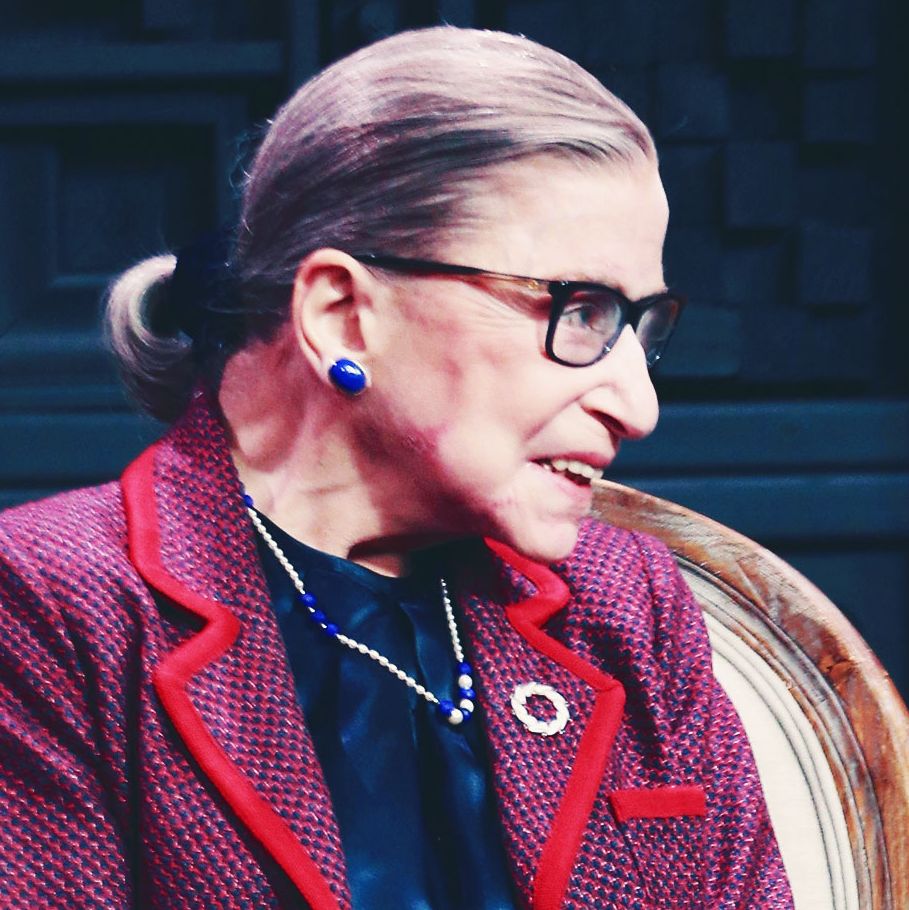

Ruth Bader Ginsburg Facts
I said on the equality side of it, that it is essential to a woman’s equality with man that she be the decision-maker, that her choice be controlling. If you impose restraints, you are disadvantaging her because of her sex…. The state controlling a woman would mean denying her full autonomy and full equality.
History Of Ruth Bader Ginsburg
Ginsburg has consistently fought for these rights. In early March, the Supreme Court heard a case against a Texas abortion law that allegedly limits the availability of abortion clinics to women in the state. Pro-choice women are counting on Ginsburg to oppose the law and, once again, stand up for what she believes. When it comes to furthering women's rights, Bader Ginsburg is an icon.